






Activated Carbon Adsorption Box for VOC Removal
Where Carbon Adsorption Fits in the VOC Control Landscape
Volatile organic compound control has three realistic options: destroy the pollutant, capture it for recovery, or concentrate it for downstream treatment. Activated carbon adsorption sits in the capture and concentration category, and it is the technology of choice when the gas stream is dilute, the airflow is large, and the VOC concentration is too low to sustain combustion without supplementary fuel. A painting line exhausting a few hundred milligrams per cubic metre is a typical candidate; a solvent-laden stream from a reactor usually is not.
The reason is physical rather than economic. Carbon holds VOC molecules on an enormous internal surface area created during activation, and it does so without heat. That makes adsorption cheap to run at low concentrations, where a thermal oxidiser would burn gas continuously just to stay alight. As concentration rises, the carbon bed saturates quickly, replacement or regeneration cost climbs, and destruction technologies become the better answer. Knowing where that crossover sits is the first engineering decision, and it usually lands somewhere around one to two grams per cubic metre depending on the compound.
How an Adsorption Box Actually Works
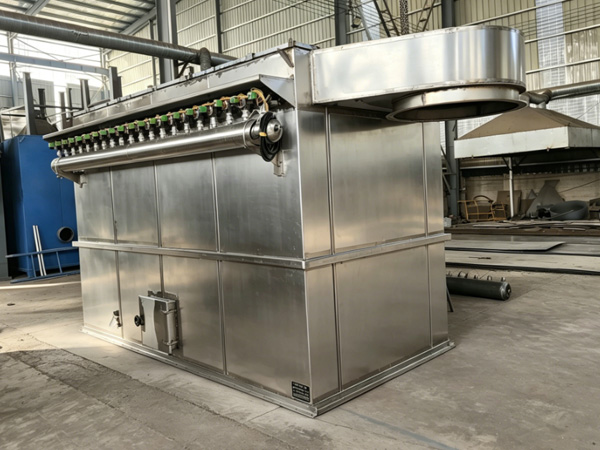
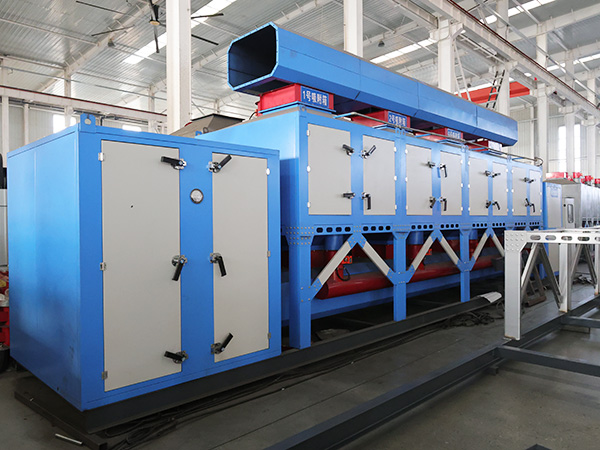
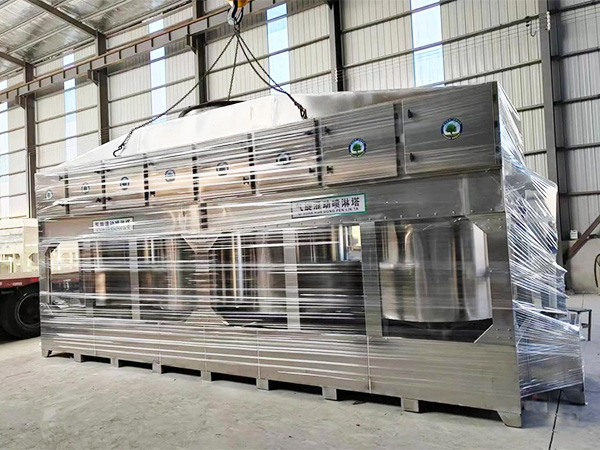
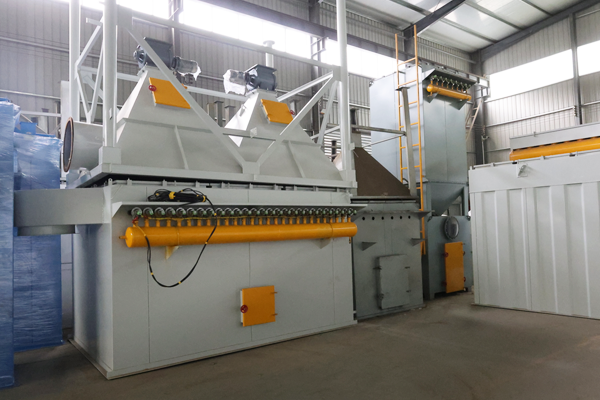
The device itself is refreshingly simple. A steel housing holds one or more beds of granular or pelletised activated carbon. Contaminated air enters, passes through pre-filtration that removes particulate, then flows through the carbon bed where organic molecules physically adsorb onto the pore surfaces. Cleaned air exits the far side. There is no chemical reaction, no flame, and no moving part in the adsorption step itself.
What separates a working installation from a disappointing one is distribution. Gas must travel through the bed at a uniform velocity, because any channel or dead zone means part of the carbon never does work while the loaded section breaks through early. Baffles, distributor plates, and adequate plenum space all serve that end. Bed support screens must retain the carbon while resisting corrosion, and access doors have to seal properly, since an air leak around the bed is simply untreated gas going straight to atmosphere.
Carbon Grade, Bed Depth, and Contact Time
Not all activated carbon behaves the same. Coal-based, coconut-shell-based, and wood-based carbons have different pore size distributions, and pore size governs which molecules are captured well. Coconut-shell carbon, with its fine micropore structure, performs well on small molecules and low concentrations; coal-based carbon offers a broader pore range that handles larger and more varied solvent molecules. Pelletised forms reduce pressure drop compared with granular forms, which matters on high-volume systems.
Two specification numbers matter most: carbon tetrachloride activity, which indicates total adsorptive capacity, and butane working capacity, which reflects capacity under realistic cyclic service. Both have standardised test methods, so a serious supplier can quote them rather than simply saying "high quality carbon". Bed depth is the other variable, usually sized to give a residence time in the range of roughly 0.5 to 2 seconds. Shallower beds are cheaper and saturate faster; deeper beds cost more in carbon and pressure drop but hold far more between changes.
Saturation, Breakthrough, and Replacement Discipline
Carbon does not fail visibly. It fills up from the inlet face outward, and the point at which VOC begins appearing in the outlet is called breakthrough. By the time outlet concentration reaches inlet concentration, the bed is spent. Left unattended, an adsorption box becomes an expensive duct with no treatment value at all, and the operators usually discover it during a complaint or a stack test.
Practical plants manage this in one of three ways. They sample outlet air periodically with a portable detector, they install fixed monitoring, or they simply replace carbon on a conservative schedule derived from solvent consumption. The last method is crude but common, and it works if the schedule is genuinely conservative. Whichever route is chosen, spent carbon is a waste stream that must be classified and disposed of properly, since it now carries the concentrated solvent. Regeneration by steam or hot gas is possible on larger installations and turns adsorption into a recovery process, but it adds equipment and complexity that only pays off at significant solvent volumes.
Safety Considerations That Cannot Be Skipped
Adsorption is exothermic, and that single fact underlies most safety requirements. Certain compounds, particularly ketones and some unsaturated organics, can generate enough heat during adsorption to raise bed temperature substantially. In a poorly cooled bed, that heat accelerates oxidation and can lead to carbon bed fires. Temperature monitoring within the bed, adequate airflow to carry heat away, and restrictions on which compounds may be admitted to a carbon system are standard precautions.
Pre-treatment also matters for safety and for carbon life. Particulate loading blinds the carbon surface rapidly, so upstream filtration is not optional. High humidity competes with VOC molecules for pore space and can reduce capacity by a large margin, which means gas above roughly 60 to 70 percent relative humidity often needs drying or dilution. Gas temperature should be controlled below roughly 40 °C, since adsorption capacity falls as temperature rises. A manufacturer that sizes equipment from airflow alone, without asking about humidity, particulate, and compound identity, is not really engineering the system.
References
ASTM International. (2019). ASTM D3467: Standard Test Method for Carbon Tetrachloride Activity of Activated Carbon.
ASTM International. (2016). ASTM D5228: Standard Test Method for Determination of Butane Working Capacity of Activated Carbon.
American Water Works Association. (2021). AWWA B604: Standard for Granular Activated Carbon.
ASHRAE. (2023). ASHRAE Handbook — HVAC Applications, Chapter on Air Cleaners for Gaseous Contaminants.
International Organization for Standardization. (2013). ISO 10121: Test Method for Assessing the Performance of Gas-Phase Air Cleaning Media and Devices for General Ventilation.