






Catalytic Combustion Equipment for Industrial VOC Control
Why Catalysis Changes the Fuel Equation
Thermal oxidation destroys volatile organic compounds by holding a gas stream at roughly 760–850 °C long enough to break the molecules apart. It works on almost anything, and it consumes a great deal of fuel doing so. Catalytic combustion runs the same chemistry on a catalyst surface that lowers the activation energy of the reaction, which drops the working temperature to somewhere between 250 and 450 °C. That difference is the entire commercial case.
Lower operating temperature means less supplementary gas, lighter insulation, less demanding metallurgy, and far lower NOx formation, since thermal NOx generation is strongly temperature dependent. It also means the equipment can be started and stopped more quickly, which suits plants with intermittent production. The trade-off is that the catalyst is selective and fragile in ways a flame is not. Thermal oxidation tolerates almost any waste gas; catalytic systems require you to know exactly what is in yours.
Inside a Catalytic Combustion Unit
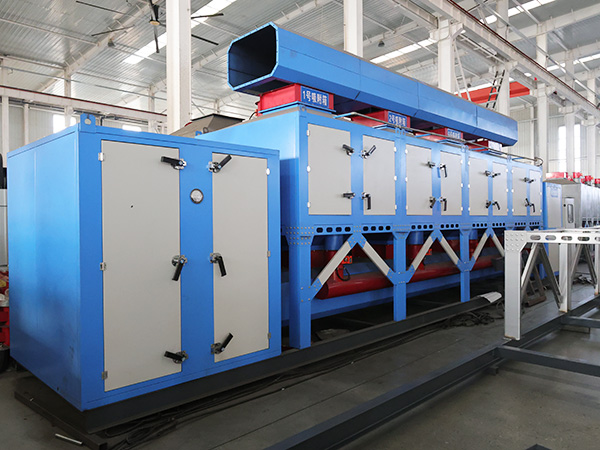
A typical unit follows a predictable path. Contaminated gas first passes through filtration or a pre-treatment stage to remove particulate and aerosol that could foul the catalyst. It then enters a heat exchanger, usually a plate-type or shell-and-tube recuperator, where outgoing clean hot gas preheats the incoming stream. A burner brings the gas up to the catalyst light-off temperature, and the gas then passes through the catalyst bed where oxidation occurs. Cleaned gas returns through the heat exchanger and exits to stack.
Many industrial designs pair ceramic heat-exchange media or a rotary regenerator with the catalyst, and these are commonly described as regenerative catalytic oxidisers. Thermal efficiencies above 90 percent are routine, and that figure determines whether the unit needs continuous burner support. In well-designed systems the heat released by oxidising the solvent itself is enough to maintain temperature, which is why catalytic combustion becomes genuinely economical once concentration reaches a modest threshold.
Catalyst Selection and What Poisoning Really Means
Catalysts are normally precious metals, platinum or palladium, dispersed on a high-surface-area washcoat over a ceramic or metallic honeycomb or pellet substrate. Palladium tends to be favoured where halogenated or oxygenated compounds are present, and its activity for certain species is notably different from platinum; the choice is application-specific and a competent manufacturer will ask for a full solvent list before recommending one.
Poisoning is the central risk, and the word covers several distinct mechanisms. Chemical poisoning means a substance reacts irreversibly with the active metal: sulphur, phosphorus, lead, arsenic, zinc, and mercury compounds are the usual offenders. Masking is milder and sometimes reversible, where a condensate or particulate physically blocks access to the active sites. Sintering is permanent thermal damage, caused by operating above the catalyst's maximum temperature, which collapses surface area. Most premature catalyst failures in the field come from the third mechanism, because an upset that pushes inlet concentration far above design can raise bed temperature dramatically in a very short time.
Concentration, Heat Recovery, and the Self-Sustaining Threshold
Every catalytic system has an autothermal point, the concentration at which the heat released by oxidation balances the heat losses, and no burner input is needed. It usually falls in the range of about 1.5 to 3 grams per cubic metre depending on the compound and the heat recovery efficiency. Below it, the burner cycles on and off and operating cost scales roughly with the shortfall. Above it, the unit runs hot and the engineering challenge shifts to controlling excess temperature.
That upward risk is why inlet concentration must be limited, typically to a fraction of the lower explosive limit, with continuous monitoring and automatic dilution air or bypass when the limit is approached. Concentrator rotors are often used upstream when the process air volume is large and the concentration is very low, because concentrating the stream first moves the operating point above the autothermal threshold. Sizing the system therefore means understanding not one operating condition but the whole range, including startup, shutdown, product changeovers, and cleaning cycles with solvent flushes.
Operation, Monitoring, and Realistic Life Expectations
Daily operation is less demanding than most people expect, provided the gas is understood. Temperature at the catalyst inlet and outlet, pressure drop across the bed, and burner status are the parameters worth logging. A falling temperature differential across the bed indicates declining catalyst activity; a rising pressure drop suggests fouling or broken substrate. Catalyst activity decays slowly and predictably, and most suppliers will quote a replacement interval of several years with periodic activity checks to confirm it.
Replacement cost is the largest single life-cycle item, so protecting the catalyst is worth real effort: maintain pre-filtration, keep the gas below the maximum rated temperature, avoid silicone-containing compounds from sealants and release agents, and never introduce halogenated solvents without checking compatibility first. Periodic activity testing lets a plant plan replacement during scheduled shutdown instead of discovering poor destruction efficiency during an emissions test. Working with an established manufacturer also means the catalyst module can be re-specified to a newer formulation when replacement comes due, which often improves performance without changing the vessel.
References
Heck, R.M., Farrauto, R.J., & Gulati, S.T. (2002). Catalytic Air Pollution Control: Commercial Technology, 2nd Edition. Wiley-Interscience.
Spivey, J.J. (1987). Complete catalytic oxidation of volatile organics. Industrial & Engineering Chemistry Research, 26(11), 2165–2180.
U.S. Environmental Protection Agency. (2017). Method 2 : Determination of Total Gaseous Non-Methane Organic Emissions as Carbon, 40 CFR Part 60, Appendix A.
European Commission, Joint Research Centre. (2020). Best Available Techniques (BAT) Reference Document for the Surface Treatment of Metals and Plastics.
National Fire Protection Association. (2019). NFPA 86: Standard for Ovens and Furnaces.