






Cyclone Dust Collector Design and Application: Separation Principles and Efficiency Optimization
The cyclone dust collector, employing centrifugal force to separate particulate matter from gas streams, represents one of the most widely used pre-separation and product recovery devices in industrial applications. These robust, low-maintenance systems, manufactured by specialized environmental equipment factories, handle high temperatures, abrasive dusts, and high dust loadings that would rapidly degrade fabric filter or cartridge collector media. Understanding cyclone design principles, efficiency drivers, and application limitations enables engineers to properly integrate these devices into comprehensive dust collection strategies.
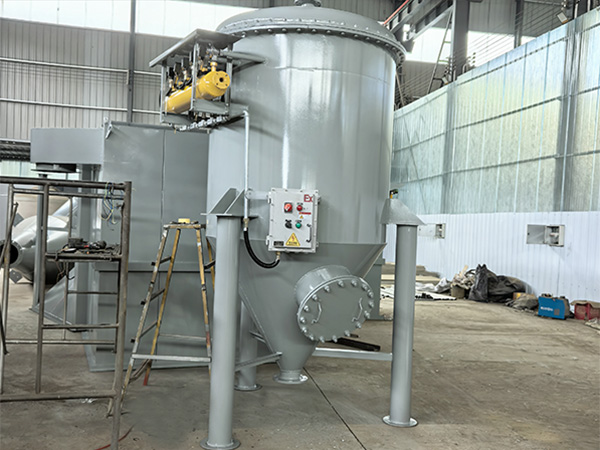
Centrifugal Separation Principles and Flow Patterns
cyclone separator operates on the principle of centrifugal acceleration, where dust-laden gas enters tangentially and spirals downward through the cylindrical or conical section, generating centrifugal forces 5-2500 times gravity depending on cyclone dimensions and gas velocity. Particulate matter, experiencing greater centrifugal force than the gas molecules, migrates outward to the cyclone wall, where it slides down into the dust collection hopper. The cleaned gas reverses direction and exits through the inner vortex finder tube at the cyclone top.
The internal flow pattern within a cyclone involves a complex double-vortex structure: an outer downward spiral (primary vortex) and an inner upward spiral (secondary vortex). This flow pattern, visualized through computational fluid dynamics (CFD) modeling, reveals regions of flow recirculation, turbulence, and potential particle re-entrainment that influence overall separation efficiency. Reputable cyclone manufacturers employ CFD modeling during the design phase to optimize inlet geometry, vortex finder length, and cone angle for specific application requirements.
Key Design Parameters Influencing Efficiency
Cyclone efficiency—the percentage of incoming particulate mass captured—depends on multiple interacting design and operating parameters. Cyclone diameter represents the primary geometric influence: smaller diameter cyclonic create higher centrifugal forces and capture finer particles, but with reduced volumetric flow capacity. For high-volume applications, multiple small-diameter cyclones configured in parallel (cyclone battery) achieve both high flow capacity and fine particle capture efficiency.
Inlet velocity, typically designed for 50-80 ft/sec (15-24 m/s), significantly influences separation efficiency and pressure drop. Higher inlet velocities increase centrifugal force but also elevate pressure drop (typically 2-6 inches w.c. for standard designs) and may cause particle re-entrainment or erosion. The ratio of cyclone body diameter to vortex finder diameter, outlet diameter, and cone length all influence performance characteristics, with optimized proportions varying based on target particle size distribution and dust characteristics.
Pressure Drop and Power Consumption Considerations
Pressure drop across a cyclone directly translates to fan power requirements and operating costs. The pressure loss results from friction losses along the cyclone walls, turbulence generation at the inlet, and kinetic energy losses in the exit stream. Empirical correlations such as the Shepherd-Schulz equation or the Barth equation predict cyclone pressure drop based on geometry, inlet velocity, and gas properties, enabling system designers to balance capture efficiency against energy consumption.
For applications involving variable flow rates, cyclone performance may degrade at off-design conditions, with reduced inlet velocity lowering separation efficiency for fine particles. Parallel cyclone configurations with isolation dampers enable阶段性 operation—activating only the necessary number of cyclones based on actual flow rates—to maintain adequate inlet velocities and separation performance while minimizing fan power consumption. Experienced cyclone suppliers provide performance curves and can recommend appropriate control strategies for variable-flow applications.
Applications: Pre-Separation, Product Recovery, and Abrasive Services
Cyclones excel as pre-separators upstream of fabric filters or cartridge collectors, removing 50-80% of incoming dust load and extending filter media life while reducing overall system pressure drop. This configuration proves particularly valuable for high dust loading applications, woodworking operations, metal grinding, and seed processing where coarse particulate would rapidly blind filter media. The cyclone handles abrasive dusts that would quickly erode sensitive filter bags, providing economical primary separation.
In product recovery applications, cyclones serve as primary separation devices for valuable particulates including grain, plastics, pharmaceuticals, and chemical powders. High-efficiency cyclone designs can achieve 95-90% collection efficiency for particles larger than 10-20 microns, enabling product recovery without the higher capital and operating costs of fabric filters. For fine powder applications, multi-clone configurations (multiple small-diameter cyclones in parallel) achieve collection efficiencies approaching fabric filters at lower pressure drop and maintenance requirements.
References
ACGIH Industrial Ventilation: A Manual of Recommended Practice, 30th Edition
EPA AP-42, Chapter 11 - Mineral Products Industry Emissions
ISO 9096 - Stationary source emissions - Manual determination of mass concentration of particulate matter
NFPA 68 - Standard on Explosion Protection by Deflagration Venting
ASME PTC 38 - Determining the Concentration of Particulate Matter in a Gas Stream