






Stainless Steel Cyclone Towers: Centrifugal Separation and Gas Washing
Introduction
Some exhaust streams carry a heavy load of particulate, oil mist, and soluble gas at the same time. Treating that mixture with a single technology is rarely efficient. A stainless steel cyclone tower combines two mechanisms in one vessel: centrifugal separation to throw out heavier particles and droplets, and optional spray washing to absorb soluble gases and finer contaminants. The result is a compact, corrosion-resistant unit well suited to harsh industrial environments that demand reliable, long-term operation. This guide explains the operating principle, the design features, and the factors that determine whether a cyclone tower is the right choice.
What the Cyclone Tower Removes
A cyclone tower is designed to remove particulate matter, dust, oil mist, and soluble toxic gases from industrial exhaust. It is used wherever the gas stream is hot, humid, or corrosive and where the equipment must withstand demanding conditions over many years. Typical applications include metallurgical operations, chemical processing, spraying, and any process that produces oily or sticky particulates alongside acidic or alkaline gases. Because the tower is built from 304 or 316L stainless steel, it resists corrosion and high temperature far better than a carbon steel equivalent, which is why it is specified for severe service.
The Power of Centrifugal Separation
The core mechanism is centrifugal force. Waste gas enters the tower tangentially at high speed, typically in the range of 15 to 25 metres per second. That entry pattern creates a strong spiral vortex inside the cylindrical or conical body. Denser particles, dust, and oil droplets are thrown outward toward the tower wall by the rotation. They lose momentum, slide down along the wall, and collect in a sump at the bottom, from which they can be drained or discharged. The cleaned gas, now largely freed of heavier contaminants, continues upward through the centre of the vortex toward the outlet. There are no moving parts in this separation stage, which is a major reason for its reliability.
Adding Spray Washing
Centrifugal separation alone is less effective on very fine particles and soluble gases. For those, a spray system can be fitted at the top of the tower. The system atomises water or a neutralising solution into a fine mist that forms a liquid film inside the vessel. As the upward-moving gas passes through this film, soluble pollutants such as sulphur dioxide, hydrogen chloride, and ammonia are captured by chemical reaction and absorption. The combination of a cyclonic flow field and a liquid film means the tower can address both particulate and gaseous pollution in a single pass, with the spray stage enhancing the performance of the separation stage.
Mist Elimination and Clean Discharge
When a spray system is used, the cleaned gas can carry entrained water droplets. A mist eliminator at the outlet captures those droplets before discharge, preventing visible plume, water loss, and downstream corrosion. The design of the eliminator and the gas velocity through it determine how effectively droplets are removed. A correctly sized unit allows the tower to discharge gas that meets emission requirements without leaving a wet, corrosive trail through downstream ductwork. Overlooking mist elimination is a common cause of complaints even when the tower itself is working well.
Stainless Steel Construction
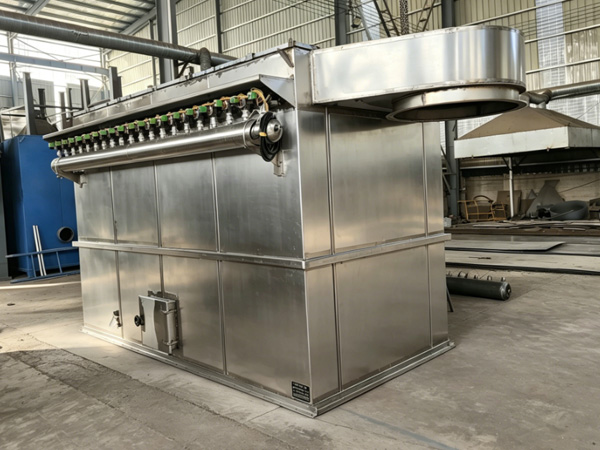
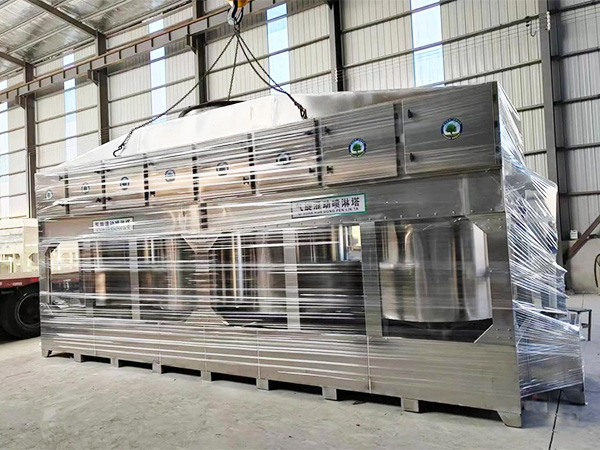
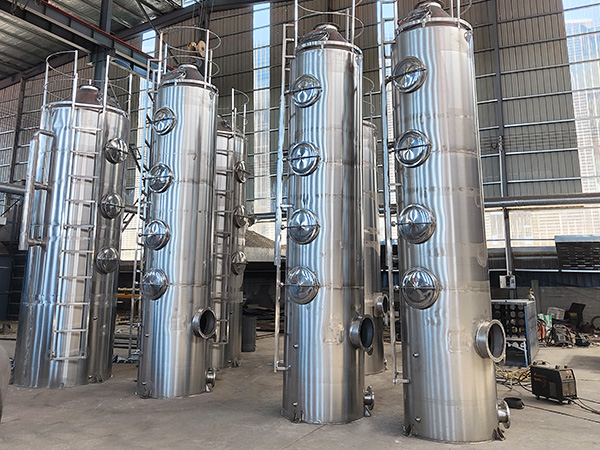
The structure of the tower — the cylindrical or conical body, tangential inlet, sump, and supports — is made from stainless steel. Grade 304 is common for general corrosive service, while 316L offers improved resistance where chlorides or more aggressive chemicals are present. The smooth interior surface also reduces the tendency of sticky dust and oil to adhere, making cleaning easier and helping maintain separation efficiency. Compared with coated carbon steel, a stainless tower does not rely on a lining that can chip or fail, which is a significant advantage when temperature cycling is involved.
Sizing and Selection
Key inputs include gas flow rate, inlet temperature, particle size distribution, contaminant composition, and required removal efficiency. These determine the tower diameter, the entry velocity, the vessel height, and whether a spray stage is needed. Entry velocity deserves particular attention: too low and centrifugal separation is weak; too high and pressure drop rises with the risk of re-entraining collected particles. The liquid supply, nozzles, and mist eliminator must be sized to match the gas load. Because the tower is often part of a larger system, its pressure drop must be accounted for when selecting the fan.
Operation and Maintenance
In service, monitor the pressure drop across the tower and the condition of the spray system. A rising pressure drop may signal accumulated solids in the sump or blockage in the mist eliminator. Check nozzles for wear and clogging, and confirm that the spray pattern covers the vessel cross-section. Drain the sump on a schedule that prevents collected material from building up and being re-entrained. Inspect the interior periodically for corrosion or deposits, especially at the tangential inlet where wear is concentrated. With straightforward maintenance, the absence of moving parts gives the cyclone tower a long and predictable service life.
Comparison with Other Separators
Engineers often compare a cyclone tower with a baghouse, a spray tower, or a simple cyclone. A plain cyclone is inexpensive and handles coarse, dry particles but is weak on fine dust and soluble gases. A baghouse achieves very low emissions on dry dust but is less suited to hot, sticky, or corrosive streams. A spray tower excels at gas absorption but consumes water and produces a liquid waste stream. The cyclone tower sits between these options, using centrifugal force for the heavier fraction and an optional spray stage for gases and finer particles. It is often chosen as a robust pre-cleaner or as the main unit where conditions rule out a fabric filter.
Frequently Asked Questions
Can a cyclone tower replace a baghouse?
For heavy, coarse, or oily particulates and corrosive gases, a cyclone tower can be the better choice. For very fine dry dust requiring very low emissions, a fabric filter is usually more effective.
Why does inlet velocity matter?
Centrifugal force depends on velocity. Too low a speed gives poor separation, while too high a speed increases pressure drop and can re-entrain collected particles. Design values are typically in the 15–25 m/s range.
When is a spray stage needed?
When the stream contains soluble gases or very fine particles that centrifugal force alone cannot capture, a spray system adds absorption and wetting to improve overall removal.
Why choose 316L over 304 stainless steel?
316L contains molybdenum, which improves resistance to chlorides and aggressive chemicals. It is preferred where the exhaust or scrubbing liquid is particularly corrosive.
Conclusion
A stainless steel cyclone tower offers a practical combination of robust centrifugal separation and optional wet scrubbing in a single, corrosion-resistant vessel. Its value lies in handling hot, humid, oily, and corrosive streams where simpler equipment would fail, and in doing so with few moving parts and modest maintenance needs. Success depends on correct inlet velocity, appropriate sizing, a well-designed spray stage where needed, and consistent attention to the sump and mist eliminator. Botou Ledi Environmental Protection Machinery Equipment Co., Ltd. supplies cyclone towers alongside complementary gas treatment and dust collection equipment, so each unit can be matched to the real characteristics of the exhaust.
References
[1] U.S. EPA – Air Pollution Control Technology Fact Sheet: Cyclone Collectors.
[2] U.S. EPA – Air Pollution Control Technology Fact Sheet: Wet Scrubbers.
[3] ISO 16890-1:2016 – Air filters for general ventilation, technical specifications and classification.
[4] U.S. OSHA 29 CFR 1910.94 – Ventilation requirements for control of dust and mist.
[5] Directive 2014/34/EU (ATEX) – Equipment and protective systems for potentially explosive atmospheres.
[6] EN 1822-1:2019 – High efficiency air filters (EPA, HEPA and ULPA), classification and performance testing.
[7] ISO 11057:2011 – Air quality, test method for filtration characterization of cleanable filter media.